The title of American Artist’s solo exhibition, “To Acorn,” references Acorn, the community in Northern California founded by Lauren Oya Olamina, the protagonist of Octavia E. Butler’s novels Parable of the Sower (1993) and Parable of the Talents (1998). The first novel is set in an alternative version of the mid-2020s as Olamina and her compatriots traverse the perilous landscape of a postapocalyptic United States. Her Earthseed movement realizes success and at the second book’s conclusion is slated to extend its influence into outer space and “take root among the stars.”
On view through March 15 at the MIT List Visual Arts Center, the exhibition is organized by Natalie Bell with Ramona Ngin, and consists of meticulously rendered drawings, an imposing sculptural installation, and a two-channel video. The works mine the writing and archives of Butler by giving visual afterlives to her ideas. In this sense, the exhibition becomes an exercise in both exegesis (the field of scriptural interpretation) and translation. The titling is furthermore indicative of a blurring of reality and representation that generally concerns Artist. As a verb, “to acorn” implies a seeding of Butler’s fictional models into reality. Acorning, giving material form to text, is one of Artist’s key tactics.
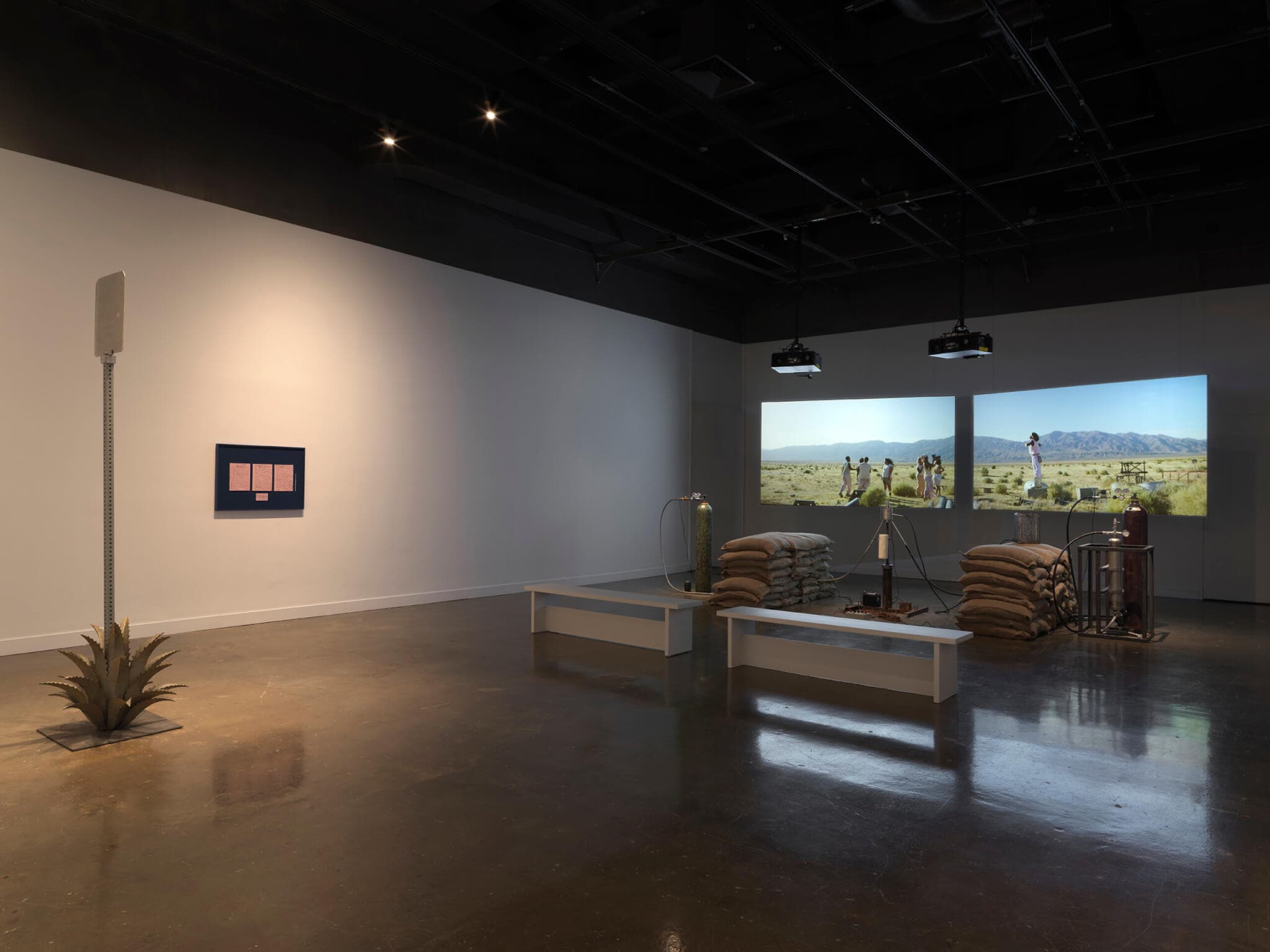
The centerpieces of the exhibition, The Monophobic Response (film) (2024) and The Monophobic Response (sculpture) (2024), take their name from Butler’s essay about humanity’s inability to unite, except possibly when faced with an alien threat. The former is a two-channel, color projection of a desert bipropellant experiment starring an ensemble cast of engineers and Butler scholars, who dress in coordinated cream and white clothing. From the view of handheld cameras and a drone, the cast greets one another, converses, and then shelters while they undertake a successful fiery experiment.
The Monophobic Response (sculpture) confronts spectators with the evidence—moved from screen to gallery—of the event. It is an arrangement of two tanks (respectively filled with methanol and oxygen), tubing, a steel booster, ignition switches, a paper roll and pencil plotter, and sandbags. With these elements, Artist introduces a real and disquieting explosive potential to a space traditionally reserved for the contemplation of aesthetic forms safely relegated to the realm of representation. These sibling works restage a rocket engine test performed at the Guggenheim Aeronautical Lab at the California Institute of Technology (GALCIT) in 1936. Artist encountered photographs and sketches by the engineer Frank Malina in NASA’s Jet Propulsion Laboratory archives. They converted the documentation into a score for a performance set in another world and undertaken by people of color (in a marked contrast to the GALCIT iteration). While replicating rocket science, the performers took on roles of the Earthseed community—improvising lines inspired by Butler’s Olamina’s ideas.
In addition to serving as the exhibition’s title, To Acorn (1985) (2022) is one of a series of sculptures of bus stop markers grounded in metal plants. In To Acorn (1985), we encounter a flawless, white rectangular sign with rounded corners, emblazoned with the RTD logo and red, orange, and yellow stripes of the now-defunct Southern California Rapid Transit District. It sits atop a square perforated steel post that blossoms out of a dark-green, metal agave at the base. Agave occurs throughout Southern California; the flora also suggests the thorn wall that is the defensive structure for Acorn’s inhabitants in the novels. To Acorn (1985)’s sign marks the route Butler would have used in 1985 as she traveled on public transit from Pasadena to the Central Library in Los Angeles.
This stretch of California, which inspired her alternative universe, is well known to Artist too, whose family, like Butler’s, arrived in Los Angeles as part of the Great Migration of Black Americans from the Jim Crow South. Artist, like Butler, grew up in Altadena and attended the same high school as Butler in nearby Pasadena several decades after her. The wall label reveals the ostensibly historical object to be an artistic creation rather than a relic. Hence, as a fabricated version of a real sign, it possesses the speculative logic of Butler’s Parable novels. Indeed, the work’s title “To Acorn” prompts the imagining of a bus destination headsign with the fictional settlement as its terminus.
American Artist legally changed their name in 2013, a gesture that is simultaneously an act of paperwork and performance art. They embrace and invert the “aesthetics of administration” that the critic Benjamin Buchloh argued characterize conceptual art: Rather than (solely) bring dry documents to the realm of art, Artist entered their practice into a government administrative system to make an aesthetic and political interrogation of subjects’ production and societal assumptions about racial identity. Artist’s concern for navigating bureaucratic institutions also extends to Octavia E. Butler Papers: mssOEB 1-9062 I (Mother to Daughter) (2022) and Octavia E. Butler Papers: mssOEB 1-9062 I (Only Dirt Roads) (2022). Each drawing is an instance of masterful draftspersonship across three pages. Artist respectively renders a bus schedule with a notation by Butler and letters from the author’s mother (Octavia M. Butler) in graphite on the signature light pink folios of the Huntington Library where the writer’s papers are archived. Pencils and call slips from the Huntington on the same pastel paper stock accompany the three-sheet drawings in the two artworks, which are both framed on blue felt mats. As the work’s titles are those of the archive and Artist had to sign the slips to request each manuscript, the library’s actual administrative materials become labels and signatures. Because photographic reproductions of the Octavia E. Butler Papers are not allowed, their delicate renderings liberate select archival materials. Confounding art and archive, text and image, handwriting and identity, Artist traced the fonts of the transit authority as well as the scripts of Butler and her mother.
Readers of Butler’s writing will be rewarded as they recognize quotations and find connections between her life and her fiction in the exhibition. For those who are not converts to the Church of Octavia, the works may seem opaque. Surely, catalyzing reading is one of Artist’s goals. Copies of Butler’s novels as well as Artist’s Shaper of God (2025), a tome with comprehensive discussions of their engagement with Butler’s legacy, is available in the reading room at the gallery’s entry. MIT’s Science Fiction Society also organized two reading group events. Reading Parable of the Sower these days is uncanny, as the dates of Olamina’s diary entries coincide with those of our present, and perhaps destabilize a sense of the inevitability of things as they are. Butler’s writing often reads more like a prophetic warning than speculative fiction. “Make America great again” is the slogan of Parable of the Talents’ fictional president and devastating wildfires swept across Los Angeles (and Altadena specifically) just last year, echoing scenes she imagined decades earlier. The exhibition’s efforts to “acorn” her ideas into the present feel less interpretive than urgently contemporary.
“Knowledge production” is a key consideration for Artist.1 With this, a further understanding of “To Acorn” emerges: It is an imperative proclamation inviting us to travel with them into Butler’s biography and bibliography, and consider ways that her “empathetic yet stark narratives about humanity’s perilous patterns and blindspots” can help sprout new trajectories.2
—1 See “American Artist: To Acorn,” MIT List Visual Arts Center, 2025, https://listart.mit.edu/exhibitions/american-artist-acorn.
—2 American Artist, et al., American Artist: Shaper of God, ed. Zainab Aliyu (Pioneer Works Press, 2025), 9 quoted in American Artist: To Acorn (Cambridge: MIT List Center, 2025), 1.
“American Artist: To Acorn” is on view through March 15, 2026, at the MIT List Visual Arts Center, 20 Ames Street, Cambridge, MA.