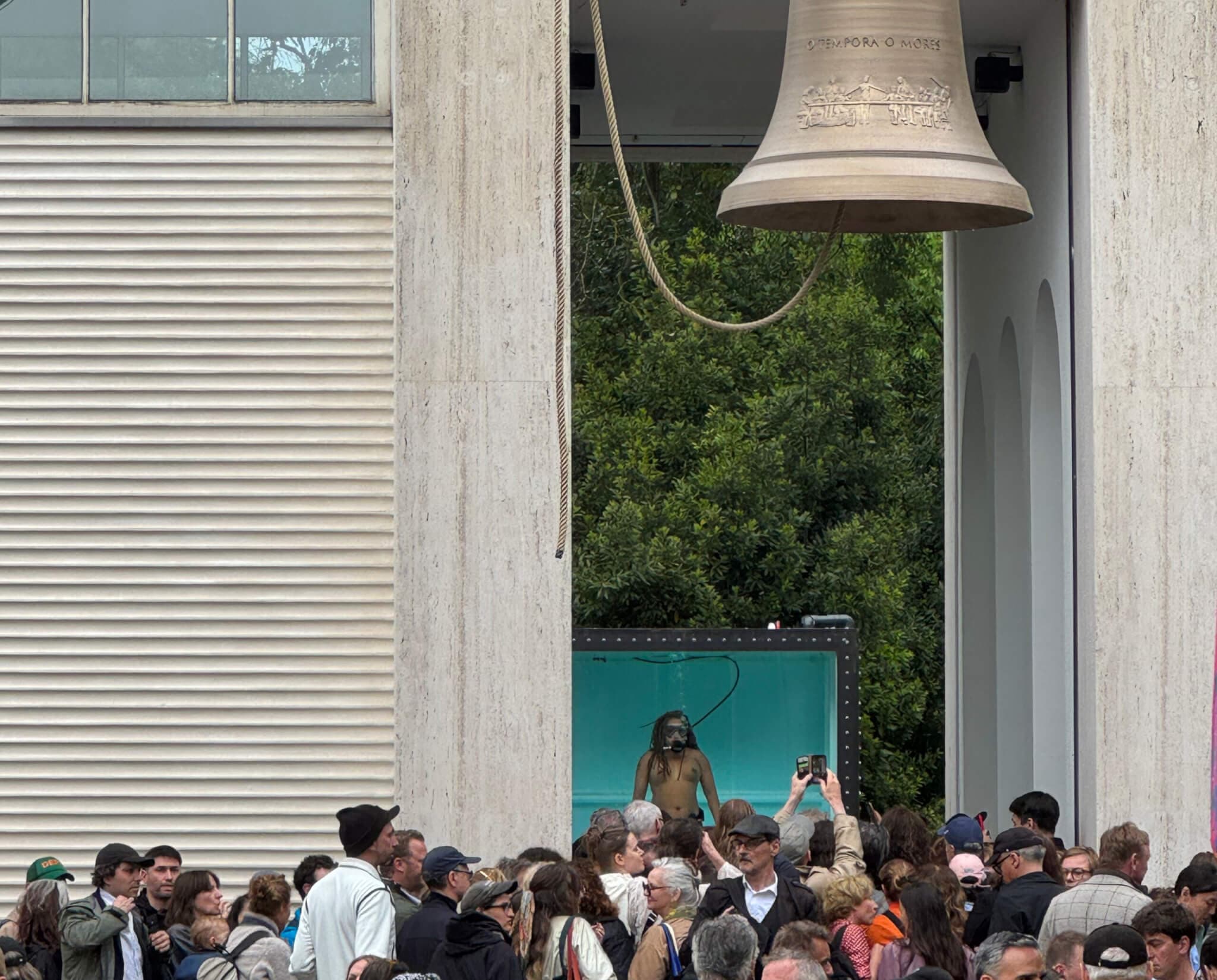
The first Monday in May is for the insiders. The politics of attending are no doubt problematic: the cost, the climate impact, and the fact that simply showing up implicitly endorses the grim politics of the institution’s new leadership. I’m not talking about the Met Gala. On May 4, international art power brokers descended on another emblematic site of cultural caché recently impacted by Bezos: Venice.
The preview days of the Venice Biennale draw crowds of international culturati to take the pulse of the global power order as expressed through contemporary visual art. It’s as if the United Nations General Assembly and Eurovision had a baby—but make it art.
A few things unfolded as expected. The quick-hit critics’ reviews called out the Biennale’s national pavilion format as outdated. Alma Allen ushered in the Vichy era of the US pavilion. His presentation was widely and roundly panned—at least in part—for how cryptic he has been in explaining why he accepted the Trump administration commission. Protestors staged demonstrations at the Russian and Israeli pavilions, which both had significant armed police presence. Curiously, the US pavilion didn’t draw any protests.
Death was a regular spectre at the 61st Venice Biennale, titled “In Minor Keys.” The sudden passing of Koyo Kouoh, the curator of the central exhibition, in 2025, led to the decision to proceed with this exhibition posthumously, prompting critic Martin Herbert to question the possibility of a posthumous critique. Henrike Naumann, an artist representing Germany, passed away in February 2026. John Beadle, representing the Bahamas, passed away in 2024. Far more omnipresent, though, was a riff on Thomas Mann’s 1912 novella: “No death in Venice” slogans, wheatpasted and graffitied throughout Venice, demanded that the Biennale ban the US, Israel, and Russia from participating due to their ongoing attacks on civilians. On April 30, the prize jury of the Venice Biennale resigned in protest of the continued participation of Israel and Russia. By May 11, over 70 pavilion artists, curators, and exhibition staff recused themselves from consideration for the newly created Visitor Lion awards, which are replacing the Gold and Silver Lion prizes. Beyond the killings of civilians and journalists in Gaza, Lebanon, Iran, Sudan, and Ukraine regularly invoked over the week, there was also the pall of a more abstract death: that of the international art system.
European and US arts institutions have been reeling from fresh rounds of cuts to social and cultural spending. At the Giardini and Arsenale, this shift toward deeper austerity manifested most clearly in leaner hospitality and promotional swag budgets. Far from trivial, this points to how the international arts system, which has long struggled to translate the contributions of social good into economic logic, has benefited in recent decades from the largess of other government agenda goals, including development aid and democracy-building industries designed to promote Western values—and how cuts to these budgets mean cuts to the arts. Call it the SWAG index: So-long pro-Western Art Gatherings.
The recent austerity cuts are a continuation of trends stemming from the European sovereign debt crisis, which arose as a result of the 2008 recession; the framing of Syrian refugees as “a migration crisis”; and the rise of far-right politics. Today, governments are cutting already emaciated arts funding due to soaring energy and defense costs. This austerity has been driven, in part, by the Trump administration pressuring allies to meet the 5 percent of GDP target for military spending and spiraling national debt fueled by persistent post-Covid inflation and rising interest rates. Policymakers have failed to internalize that austerity measures don’t work, and the US’s strong-arming of Europe to increase military investment translates into cuts to cultural spending. The Trump administration, it appears, is using defense and economics policy as a cudgel to drive changes to European cultural policy that are more aligned with its views. These cuts to state programs that fund artists, museums, and social programs around the world call to mind Mayor Wu’s proposed budget cuts, which would eliminate funding for organizations that bring arts, culture, and social services to BIPOC, LGBTQ+, and youth communities, and that triggered residents to testify in protest at a Boston City Council meeting.
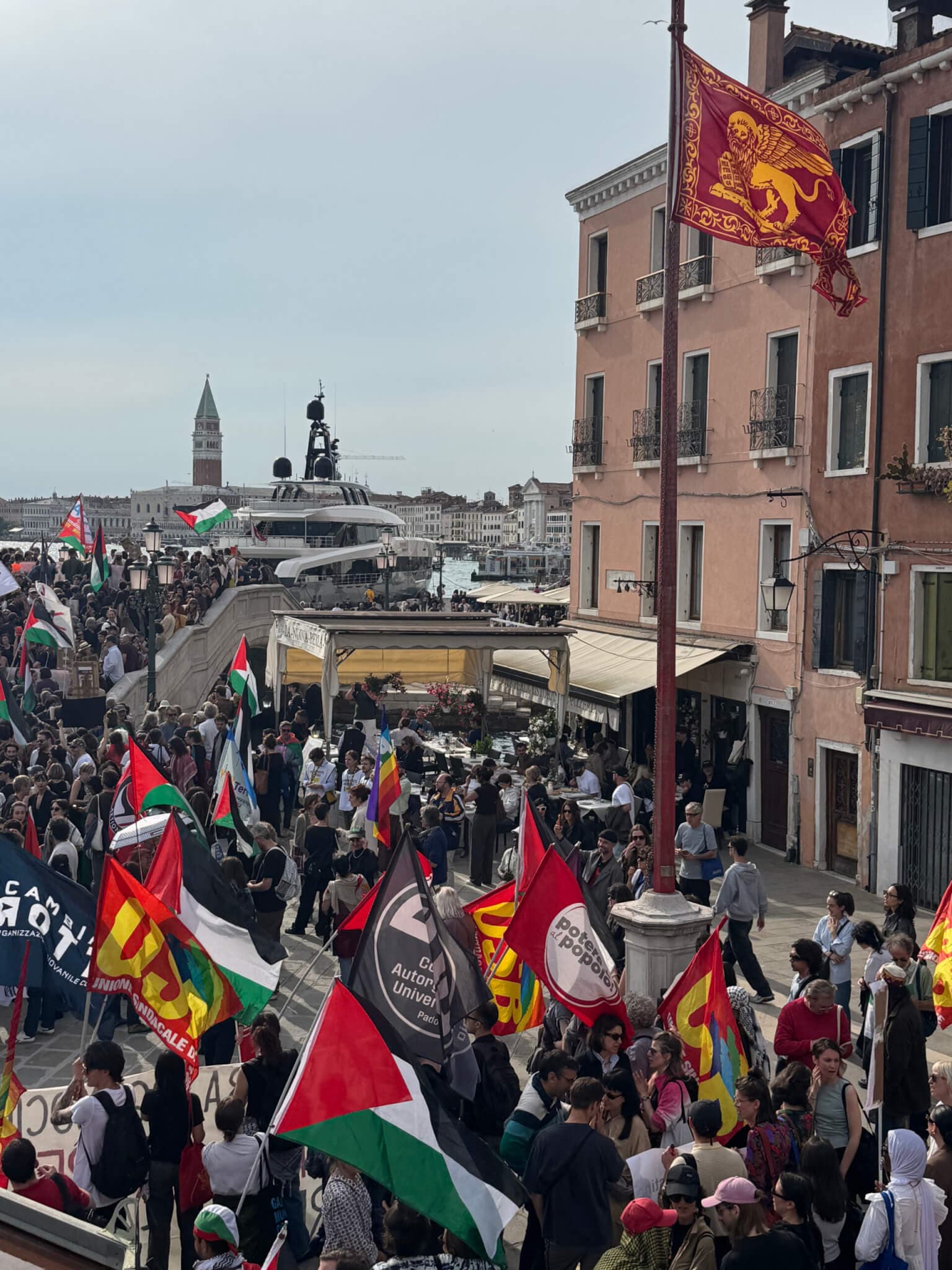
Art Not Genocide Alliance organized the first labor strike in the Venice Biennale’s history on May 8, the last of the preview days. Protestors marched from Via Garibaldi to the Arsenale before being confronted by riot police.
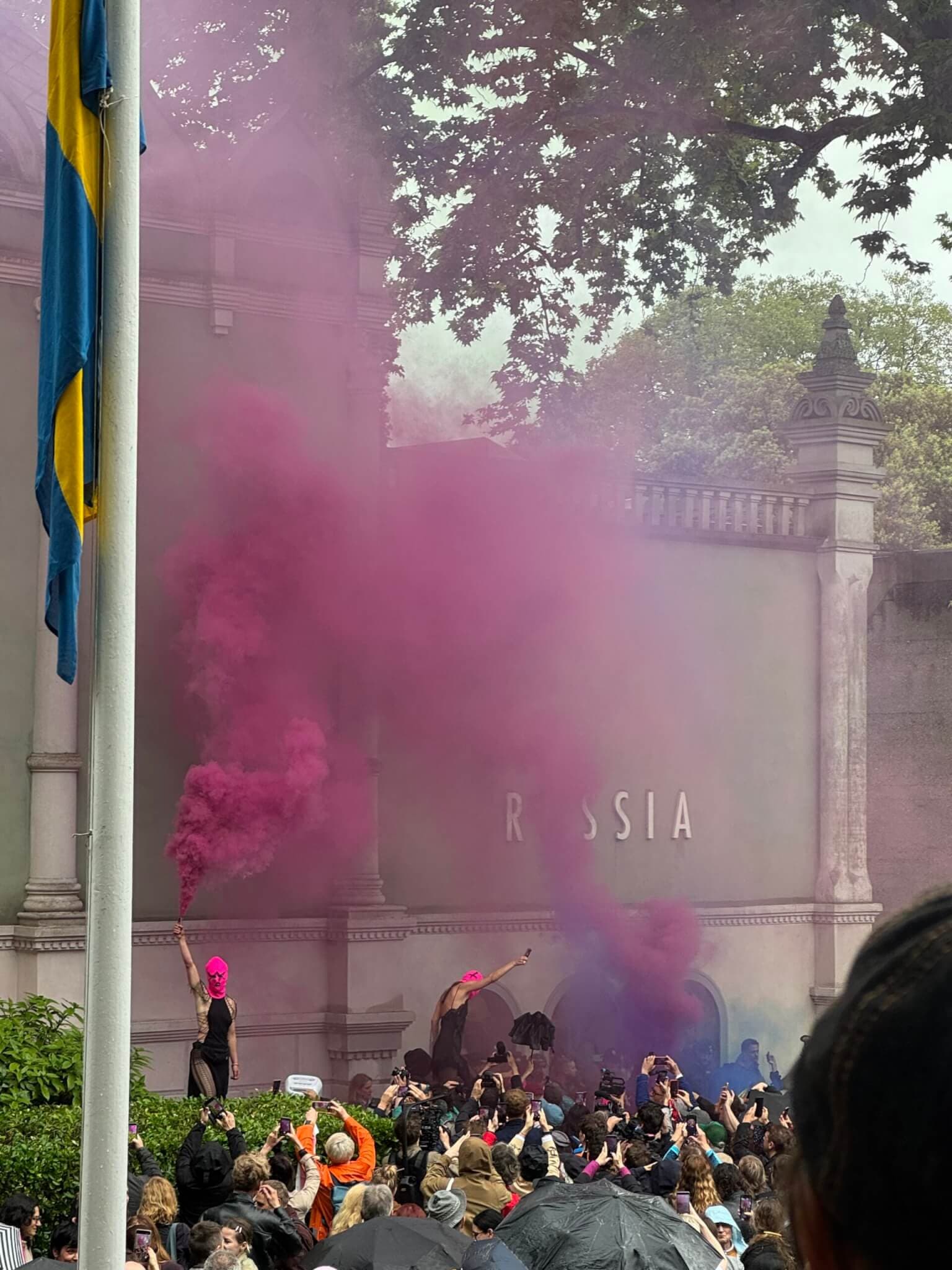
Pussy Riot and FEMEN activists staged a protest in front of the Russian pavilion in the Giardini on May 5, during the first preview day. Photos by Kim Córdova.
France, Germany, Italy, and the Netherlands (to name a few) are all NATO member states that, in the last year, have announced significant austerity reforms, including cuts to arts and culture budgets.1 Reinforcing how cuts to cultural budgets are connected to increased military spending, the Art Not Genocide Alliance (ANGA) confirmed via email that the Biennale strike on the third day of the preview was co-organized with the Biennale workers’ coalition Biennalocene, the cultural heritage association Mi Riconosci, the national art workers’ assembly Vogliamo Tutt’altro, and the Italian trade labor unions ADL Cobas, CUB, and USB. In organizing a walkout of twenty-three national pavilions, the coalition connected the precarious conditions of arts and culture workers to the Biennale Foundation’s politicization of the institution by allowing countries accused of war crimes to participate. “The strike rejects the normalization of Israel’s presence in cultural spaces and the economies of genocide, while also confronting the precarious labor conditions underpinning the Biennale. These conditions reflect the broader insecurity faced by cultural workers and the resulting lack of agency in asserting their rights. No artist or cultural worker should be asked to share a platform with a state accused of genocide,” ANGA representatives said in an emailed statement.
Jason Farago argued in the New York Times that the Biennale’s national pavilion format is unhelpful and should be done away with. The error in this interpretation is that it ignores how the end of the post-war, US-led, Western, monopolar moment—or what political scientist Francis Fukuyama called “the end of history”—is triggering nationalism and re-regionalization around the world. Countries are now more incentivized to act based on their views and self-interest, and less on cooperative values. The downstream effect is that artists may have a harder time finding opportunities to show their work internationally. As long as the nation-state remains the basic unit of international relations, these trends give new relevance to the Biennale’s national pavilion format rather than render the Biennale an anachronism.
If the Biennale is a snapshot of contemporary global power through art, then perhaps its most outdated aspect is the absence of corporations in its programming, particularly companies like Microsoft or Google that have achieved state-like wealth and power. It’s possible that this year, the Biennale Foundation signaled a future with more corporate participation. Bulgari, a jewelry company owned by the world’s largest luxury goods conglomerate, LVMH, opened a pavilion in Spazio Esedra at the Giardini, a building typically used for special projects. The company’s ‘pavilion’ is meant to celebrate its standing as “the Exclusive Partner for the next three editions of Biennale Arte,” featuring work by Canadian artist Lotus L. Kang. Bulgari has not announced how much it paid for this partnership, and the company does not carry the same geopolitical sway as Amazon, SpaceX, or Taiwanese semiconductor manufacturer TSMC. But as public funding for cultural initiatives dwindles and corporations increasingly seek to capitalize on the soft power that art offers, it’s possible this signals that the Biennale Foundation is open to giving access to more contemporary forms of power. What’s less clear is whether contemporary art holds enough sway with public opinion to pique corporate interests.
The politics of how each country commissions and funds its participation in the Venice Biennale reflects its political economy and systems. When art intersects with government, the line between artwashing, propaganda, and the value art brings to international relations can become vanishingly thin. But instead of discounting the project of showing art under national banners as too co-opted by politics to be useful, what if we consider it one more reason we need critics, journalists, and academics to do the work of parsing one from the other?
Representing Austria, artist Florentina Holzinger said in her pavilion-opening remarks, “Nothing is what it used to be. This world is crumbling, living inside a failing system.” In light of the simultaneous emergencies caused by the collapse of the international order, it’s clear that the center has stopped holding. But as global orders fracture, leaving frameworks for government-led cooperation and support for the arts to fall apart, isn’t it more important than ever to create mechanisms for coming together through cultural exchange?
This Week’s Wonk
Boston’s New Cultural Center La CASA Opens
This Friday, the Center for the Arts, Self-determination and Activism (La CASA), a new Latinx arts center, will open in Boston’s South End. Designed by Studio Enée, the center is envisioned “as the hub for Latinx arts and activism in New England.” It will be located within the affordable housing developer Inquilinos Boricuas en Acción’s Villa Victoria community.
Michelle Millar Fisher Announced as Chief Curator of Cooper Hewitt
Michelle Millar Fisher, the Ronald C. and Anita L. Wornick Curator of Contemporary Decorative Arts within the Contemporary Art Department at MFA Boston (and occasional BAR contributor), has been announced as the new chief curator of the Smithsonian’s Cooper Hewitt, a museum dedicated to design, craft, and applied arts. Millar Fisher brings a reputation for feminist curatorial practice to the role, along with a history of labor organizing in the arts.
Youth Dream of Leaving Boston
A Greater Boston Chamber of Commerce Foundation survey of 600 young adults (ages 20–30) living in the Greater Boston area found that roughly 25 percent of residents plan to leave the area in the next five years, citing the costs of housing and healthcare and a lack of affordable third spaces.
Mayor Wu Praises Fidelity’s New Back-to-Office Plan
Speaking with WBUR, Mayor Wu praised the controversial news that Fidelity, one of Boston’s largest employers, is following in the footsteps of JPMorgan Chase CEO Jamie Dimon by calling for a full-time return to the office. Hailing the move, which workers cite as infringing on their work-life balance, Mayor Wu echoed the sentiments of the commercial real estate trade organization NAIOP Massachusetts and praised the decision as great news for small businesses. As with the JPMorgan back-to-office mandate, which coincided with a splashy new building, Fidelity will also inaugurate new offices in the Seaport this year. Mayor Wu’s praise comes as the City navigates a complex financial outlook caused by declining income from real estate construction.
US Dept of Education Targets Smith College for Admitting Trans Students
The Department of Education is investigating Smith College, a private liberal arts women’s college, for accepting trans women. The department alleges that the school is in violation of Title IX, which prohibits discrimination based on sex. The probe is part of the administration’s ongoing efforts to limit trans people’s rights.
Live at the Rat Turns 50
Boston Globe’s Camille Bugayong serves up a fun history of punk album Live at the Rat, recorded fifty years ago in commemoration of the legendary venue The Rathskeller—better known as The Rat—which served as a fixture of Boston’s 1970s punk scene.
US Debt Exceeds Size of the Economy
The US national debt now exceeds the US’s GDP. Other countries hold debt greater than their GDP, but the US’s role in the global economy makes this particularly unusual. Experts are divided on what this means for the US—and for the US dollar.
Calls to Action
The Queer Neighborhood Council of Boston Calls on Community and Allies
The Queer Neighborhood Council of Boston is calling on community members and allies to speak out about how Mayor Wu’s proposed “budget eliminating funding for grants to community orgs serving Boston’s LGBTQIA2S+ communities, people with disabilities, immigrants, youth, elders, and others in need” will affect them.
City Councilors are Inviting Additional Budget Feedback in Town Hall on Thursday, May 14
In response to recent public advocacy around Boston’s budget cuts, City Councilors Miniard Culpepper, Julia Mejia, and Brian Worrell are hosting a town hall to make public engagement on the budget process more accessible. Attendees are invited to share priorities and demands regarding the FY27 budget.
Date: Thursday, May 14, 2026
Time: 5–8 PM
Location: The Dewitt Center gym (122 Dewitt Dr., Boston, MA 02120)
Interpretation available: Spanish and Haitian Creole
—1 The European Commission’s withdrawal of funding from the Biennale Foundation, the organization that administers the Venice Biennale, in response to Russia’s inclusion in the event is a separate issue. The European Commission is the executive body of the EU and funds cultural initiatives; it is not itself a nation-state. It withdrew funding for the Biennale Foundation in response to President Pietrangeli Buttafuco’s decision to allow Russia to participate in the 61st Venice Biennale, citing Russia’s violations of EU sanctions.